Subscription Hub
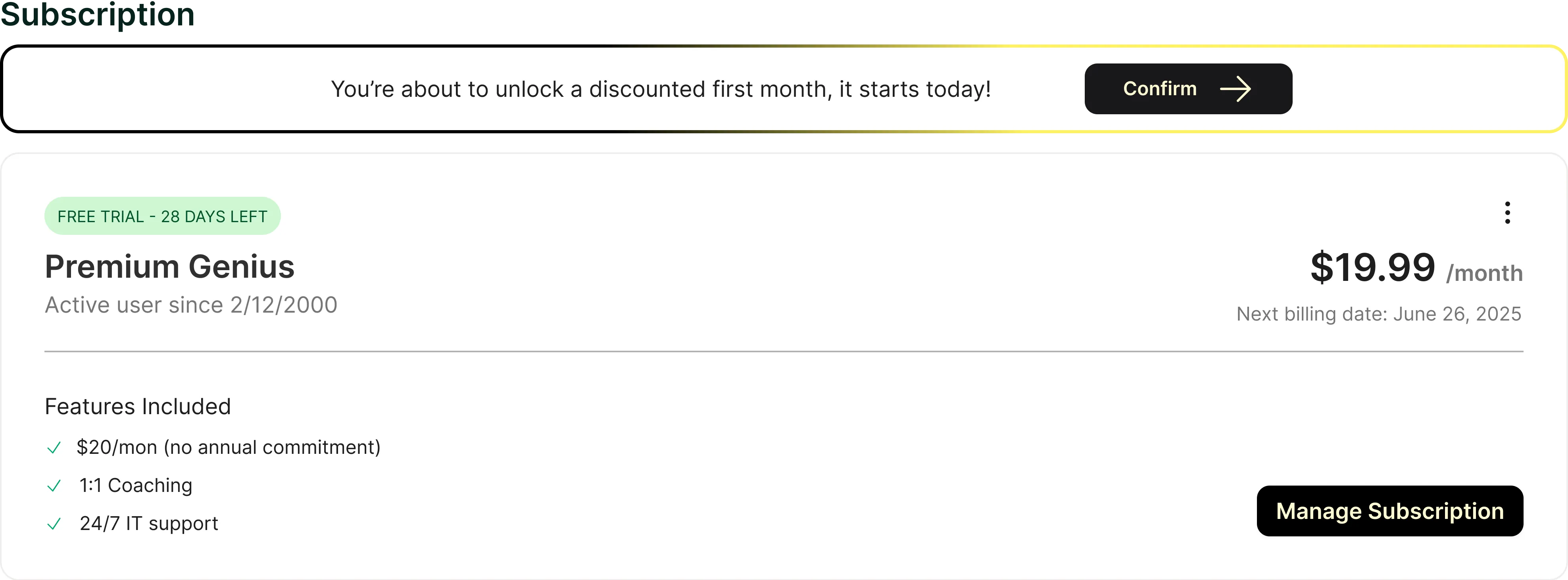
The SubscriptionHub is the quickest way to get started with SubscriptionManagement. The SubscriptionHub will render a subscription management widget to the container and manage the entire subscription management and retention workflow.
Implementation
Section titled “Implementation”TypeScript/JavaScript
Section titled “TypeScript/JavaScript”You can embed the Subscription Hub directly into your application:
renumerate.mountSubscriptionHub("elementId", "sessionId", "classes");mountSubscriptionHub Arguments
Section titled “mountSubscriptionHub Arguments”| key | type | notes |
|---|---|---|
| elementId | string | The id for the container element |
| sessionId | string | Your customer’s subscription session id |
| wrapperClasses | string | undefined | Wrapper element classes (optional) |
| iframeClasses | string | undefined | Iframe element classes (optional) |
| callbacks | object | undefined | Event callbacks (optional) |
Adding Callbacks
Section titled “Adding Callbacks”You can add callback functions to respond to subscription management events:
Callbacks
Section titled “Callbacks”| key | type | notes |
|---|---|---|
| onComplete | () => void | Called when the retention flow is finished (optional) |
| onRetained | () => void | Called when the customer is retained (optional) |
| onCancelled | () => void | Called when the customer cancels (optional) |
renumerate.mountSubscriptionHub( "elementId", "sessionId", "hub-wrapper", "hub-iframe", { onComplete: () => { // Called when any action is completed console.log("Subscription action completed"); }, onRetained: () => { // Called when customer accepts a retention offer during cancellation console.log("Customer was retained!"); }, onCancelled: () => { // Called when customer completes cancellation console.log("Customer cancelled subscription"); } });For React applications, use the SubscriptionHub component for seamless integration:
Basic Setup All Renumerate React components must be wrapped in a RenumerateProvider:
import React from 'react';import { RenumerateProvider, SubscriptionHub } from '@renumerate/js/react';
function App() {  const sessionId = "sub_example123";
  return (    <RenumerateProvider config={{      publicKey: 'your-public-key',      fallbackEmail: 'support@yourcompany.com'    }}>      {/* Default SubscriptionHub */}      <SubscriptionHub sessionId={sessionId} />
      {/* Styled SubscriptionHub with callbacks */}      <SubscriptionHub        sessionId={sessionId}        wrapperClassName="custom-hub-wrapper h-96 w-full border rounded-lg"        iframeClassName="w-full h-full rounded-lg"        callbacks={{          onComplete: () => {            console.log("Action completed in subscription hub");          },          onRetained: () => {            alert("Great! Your subscription has been saved.");          },          onCancelled: () => {            window.location.href = "/goodbye";          }        }}      />    </RenumerateProvider>  );}
Generating a SubscriptionHub session id
Section titled “Generating a SubscriptionHub session id”Subscription sessions allow you to present the SubscriptionHub widget to your customers to easily manage and view their subscriptions.
Subscription sessions begin with sub_
To generate a customer’s session ID, make a POST request to https://api.renumerate.com/v1/subscription/session from your application’s backend.
Ensure the following:
- Include the
X-Brand-Keyheader with your Brand’s private key for authentication. See the Where To Find Private Key section. - Pass the customer’s ID or email in the request body as specified below.
This process securely creates a session ID that grants the customer access to their subscription management portal.
Request Body Parameters:
When generating a SubscriptionHub session, you must include either the customer_id or customer_email (or both). Below is a table of all available parameters:
| key | type | notes | |
|---|---|---|---|
| subscription | object | ||
| subscription.customer_id | string | undefined | Your stripe customerId | |
| subscription.customer_email | string | undefined | The customer’s email address in stripe | |
| subscription.subscription_id | string | undefined | The specific subscription id (optional) |
Backend Example
Section titled “Backend Example”Node.js/TypeScript
const privateKey = process.env.RENUMERATE_PRIVATE_KEY;
const requestBody = {  subscription: {    customer_id: "cus_NffrFeUfNV2Hib", // Example stripe id    subscription_id: "sub_1MowQVLkdIwHu7ixeRlqHVzs", // Your specific subscription  },};
const response = await fetch("https://api.renumerate.com/v1/subscription/session", {  method: "POST",  headers: {    "Content-Type": "application/json",    "X-Brand-Key": privateKey,  },  body: JSON.stringify(requestBody),});
const {  session: { id },} = await response.json();